
Using Secured Bridging Loans for UK Property Purchase and Renovation
There is a thrilling point in every property investor’s journey where a golden opportunity lands right in front of them. It might be a severely run-down Victorian terrace sitting at an auction house for a fraction of its market value, or a commercial space ripe for a permitted development conversion. But then reality sets in.
The auction rules state you must complete the purchase within 28 days, or the property is completely un-mortgageable because it lacks a working kitchen or bathroom. If you approach a traditional high street bank, their underwriting department will likely take up to three months just to process the paperwork.
When time is your biggest enemy, waiting around isn’t an option. This is exactly where secured bridging loans in UK come into play. They act as an elite financial springboard, providing the swift liquidity required to secure real estate assets, fund extensive renovations, and maximise capital gains.
What Are the Key Advantages of Secured Bridging Finance?
Before jumping into the mechanics, it helps to answer a foundational question: What is a secured bridging loan? At its core, it is a short term secured loan specifically designed to “bridge” a temporary financial gap.
Unlike a standard bank loan that focuses heavily on your monthly personal income, a property secured bridging loan is underwritten based on the value of the underlying real estate asset and a realistic exit strategy. The primary benefit here is speed.
As these are structured as an asset secured bridging loan, lenders face lower default risks. As a result, funds can often be disbursed into your bank account in as little as 72 hours to 5 days. This rapid deployment allows you to buy properties at a massive discount, secure competitive auction lots, or start a time-sensitive construction schedule without stalling.
Additionally, these structures are incredibly flexible. The vast majority of loans feature rolled-up or deferred interest, meaning there are absolutely no monthly servicing payments required during the loan term. The entire debt is simply cleared in one lump sum at the very end.
Why Do Property Investors Use Secured Bridging Finance for Refurbishment?

If you are planning a fix-and-flip or converting an old structure into multiple flats, traditional mortgages simply won’t work. Mainstream lenders expect a property to be immediately habitable. If a building has structural issues or missing basic facilities, it will fail the valuation.
Experienced investors intentionally use a secured property bridging loan to bypass this hurdle. Bridging facilities look past the current dilapidated state of a building and focus on its Gross Development Value, what the asset will be worth once the renovations are fully finished.
For heavy construction work, top-tier development finance lenders in UK can structure a facility to advance up to 85% of the initial purchase price, while simultaneously funding 100% of the ongoing refurbishment costs in staged tranches.
Once the renovations are complete and the property is restored, the investor can seamlessly transition onto a long-term bridging loan for mortgage product or sell the asset for a healthy profit to clear the bridge.
Also Read – How Do Property Development Loans Work in Real Estate Projects?
Is Secured Bridging Finance Ideal for Office and Retail Properties?
Yes. The commercial sector is highly fast-paced, and delays can ruin a lucrative business deal.
Whether you are repurposing an empty high-street retail unit into a trendy restaurant or updating an outdated office block, a commercial secured bridging finance facility provides the agile funding needed to snap up the real estate.
Once the commercial asset has been fully modernised and populated with reliable commercial tenants, you can easily use a commercial mortgage estimator to determine your long-term refinancing options.
Moving the stable, income-generating asset over to the best commercial mortgage UK market has to offer allows you to lock in low, multi-year interest rates and pull your initial investment capital back out for the next project.
What Is the Difference Between a Bridging Loan and a Personal Loan?
It is easy to confuse short-term borrowing products, but these two facilities serve entirely different purposes.
| Feature | Bridging Loan | Personal Loan |
| Collateral | Always secured against property or land | Typically unsecured |
| Loan Size | From £25,000 to £25M+ | Usually capped at £25,000 to £50,000 |
| Underwriting Focus | Asset value and exit strategy | Personal credit score and monthly salary |
| Repayment Structure | Rolled-up interest paid at the end | Fixed monthly installments |
When answering are bridging loans secured, the answer is always yes. When considering what is a bridging loan secured against, it is always backed by physical assets like residential houses, commercial buildings, or land.
This tangible backing is precisely why you can access millions of pounds in funding within days, whereas a personal loan is completely limited by your personal paycheck.
How Do You Secure the Lowest Interest Rate on Bridging Loans?
Bridging interest is calculated on a monthly basis rather than annually (typically ranging from 0.44% to 1.5% per month). Because minor rate variations can dramatically affect your overall project profitability, securing the sharpest terms is crucial.
To land the best possible deal, you need to drive down your Loan-to-Value (LTV) ratio. The more equity or deposit you bring to the table, the lower the risk for the lender, which immediately unlocks premium interest tiers.
Secondly, you must present a bulletproof, unambiguous exit strategy. Lenders want to see a definitive plan showing exactly how they will be repaid within 12 to 18 months, whether that is through a guaranteed sale or a confirmed clean switch to a mainstream commercial mortgage.
Also Read – Commercial Mortgages for Retail, Offices & Investment Properties
Navigating the Market with Best Bridging Loans
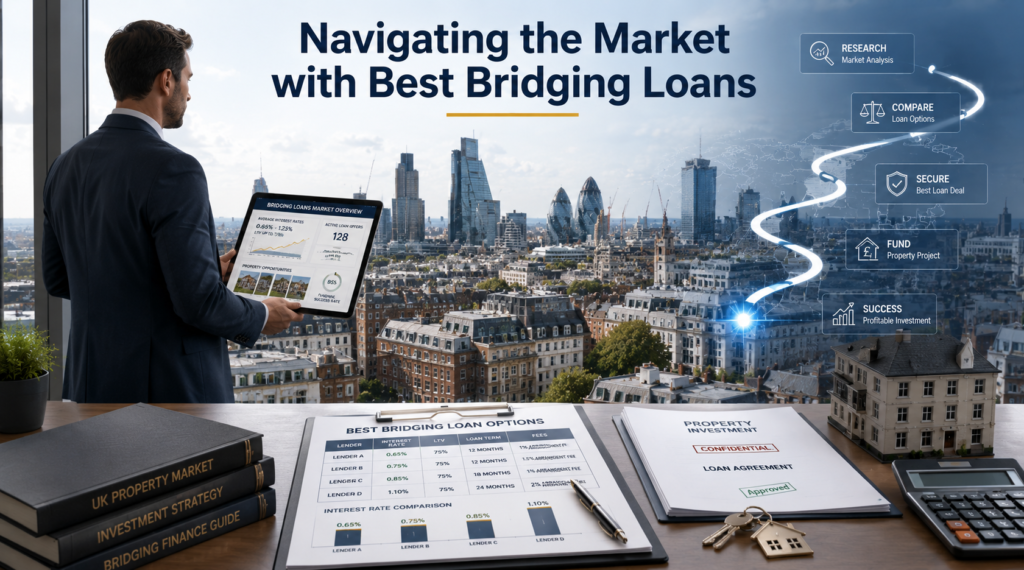
The specialist finance market moves rapidly, and the ideal lender for a light residential flip might be completely wrong for a major commercial conversion. This is where partnering with an elite specialist broker like Best Bridging Loans changes the game.
Instead of leaving you to navigate hundreds of niche criteria on your own, we leverage our extensive network of high-street banks, private funds, and boutique family offices to find the most reasonable bridging loans UK market has to offer.
We don’t believe in generic, box-ticking algorithms. We take the time to analyse your specific project, optimise your application, and package your exit strategy so lenders see minimum risk.
Whether you are looking for agile secured bridging loans in UK to beat a fierce auction deadline or need structured development funding to rebuild an office space, we handle the heavy financial lifting so you can focus on building your property portfolio.
FAQs
- Are bridging loans secured?
Yes, all bridging loans are strictly secured against tangible real estate assets or land to protect the lender’s capital.
- How long do secured bridging loans UK terms typically last?
Most short-term property bridging facilities are arranged for terms spanning anywhere from 1 to 24 months.
- Can I repay a bridging loan early without penalties?
Many premier lenders offer daily interest structures with no exit fees, meaning you only pay for the exact days the loan is open.
- What can a bridging loan be secured against?
A bridge can be secured via a first or second charge against residential houses, commercial units, buy-to-lets, or development land.
- Do I need proof of personal income to qualify?
No, because repayment relies on your property exit strategy (sale or refinance), personal monthly income is not the main deciding factor.
Discover the Latest Trends
Stay informed with our latest articles and resources.