
Bridging Loans for Property Refurbishment in the UK
Refurbishment projects rarely wait. A strong deal appears, the numbers make sense, and suddenly timing becomes critical. Traditional lenders tend to move slowly, especially when a property needs work. That gap is exactly where bridging loans refurbishment solutions fit.
For investors, developers, and even homeowners, bridging finance can unlock opportunities that would otherwise be missed.
What Is Bridging Finance for Property Renovation?
Bridging finance for refurbishment is a short-term secured loan used to purchase, refinance, or renovate a property when standard mortgage funding is either unsuitable or too slow.
It is important to be clear here. Bridging lenders focus heavily on two things:
- The value of the property, both current and after works
- Your exit strategy
Income still matters, but it is not always the primary deciding factor.
Common uses include:
- Buying auction properties that need work
- Renovating unmortgageable homes
- Refurbishing before refinancing onto a buy-to-let mortgage
- Adding value before selling
The key advantage is speed, but that speed comes with higher costs and tighter timelines.
How Do Bridging Loans Work for Property Refurbishment Projects?
A bridging loan is secured against a property. In most cases, the property being purchased acts as the main security, although additional assets can sometimes be used.
You borrow funds for a short period, usually between 3 and 12 months, though some lenders may extend up to 18 or 24 months depending on the deal.
During this time:
- You complete the refurbishment
- Interest is either paid monthly or rolled up into the loan
- The loan is repaid through sale or refinancing
Key points to understand clearly:
- Loan-to-value typically ranges from 65 to 75 percent, depending on the lender and project
- Heavier refurbishment often reduces the maximum LTV
- Interest is calculated monthly rather than annually, as with standard mortgages
Example (realistic scenario):
Purchase price: £200,000
Refurbishment cost: £40,000
Loan: £140,000 (70% LTV)
After the work is completed, the property is valued at £300,000. You refinance onto a buy-to-let mortgage and repay the bridging loan.
Profit depends on total costs, which are often underestimated.
Also Read – A Comprehensive Guide to Commercial Loan Estimators in the UK
Types of Bridging Loans for Renovation
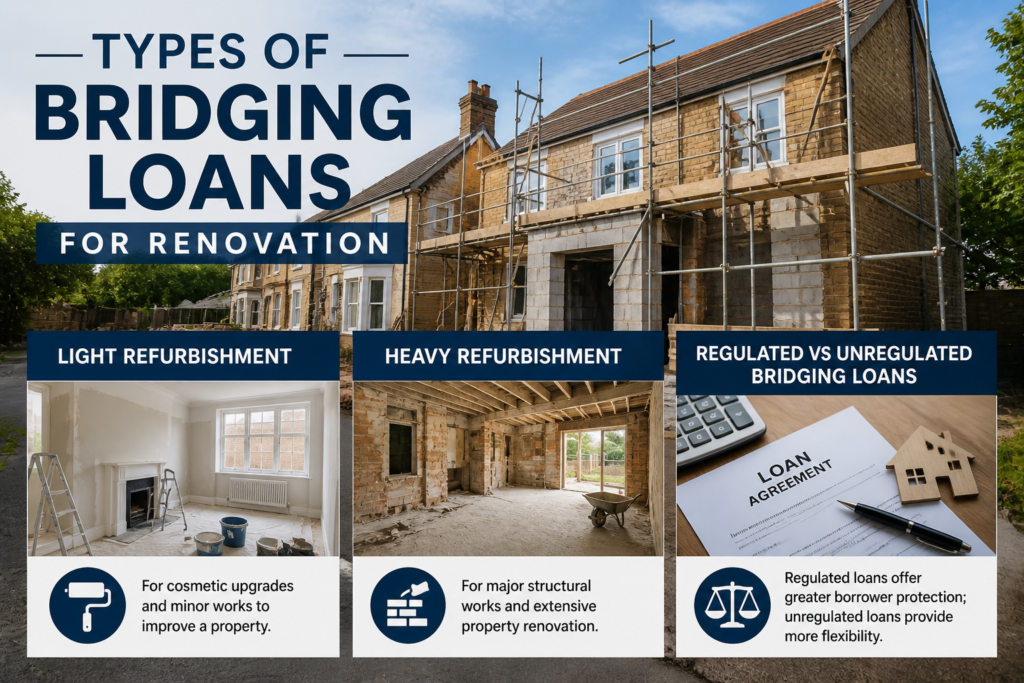
Not all refurbishment projects are treated equally by lenders, and this is where confusion often arises.
Light Refurbishment
This includes non-structural improvements such as:
- Decorating
- Kitchen or bathroom replacement without layout changes
- Flooring
These projects are considered lower risk and are generally easier to finance.
Heavy Refurbishment
This involves structural or complex work such as:
- Extensions
- Loft conversions
- Major layout changes
- Properties requiring planning permission
These loans carry more risk. In some cases, lenders release funds in stages rather than upfront.
Regulated vs Unregulated Bridging Loans
- Regulated: If you or a family member will live in the property
- Unregulated: For investment or business purposes
This distinction affects both lender choice and regulatory requirements.
How to Get Bridging Finance in the UK
The process is relatively straightforward, but approval depends on how well prepared you are.
Practical steps:
1. Define the project clearly
Provide realistic costs, timelines, and expected end value. Overestimating value is a common mistake.
2. Build a clear exit strategy
This is essential. Selling or refinancing must be achievable within the loan term.
3. Get a professional valuation
Most lenders require an independent valuation before issuing a formal offer.
4. Work with a specialist broker
An experienced commercial mortgage agent can connect you with lenders that are not directly accessible to borrowers.
5. Submit documentation
This may include ID, property details, a refurbishment schedule, and proof of deposit.
6. Complete the legal process and receive funding
Both your solicitor and the lender’s solicitor must complete checks before funds are released.
A bridging finance calculator UK can provide an early estimate, although final costs vary depending on the lender and the level of risk.
How Quickly Can You Get a Bridging Loan?
Speed is a major advantage, but timelines depend heavily on preparation.
Typical timeline:
- Initial decision: 1 to 3 days
- Valuation and underwriting: 3 to 7 days
- Legal process: 5 to 14 days
In straightforward cases, funding may be completed within 7 to 10 days. More complex refurbishment projects usually take longer.
Claims of funding within 48 hours do exist, but these are rare and typically apply only to very low-risk cases.
Costs You Need to Factor In
Bridging loans are significantly more expensive than traditional mortgages, so understanding the full cost is essential.
Typical costs include:
- Interest: approximately 0.6 to 1.2 percent per month
- Arrangement fees: usually 1 to 2 percent
- Valuation fees, depending on property value
- Legal fees for both borrower and lender
- Broker fees, where applicable
Additional costs may include:
- Exit fees
- Monitoring fees for staged refurbishment projects
It is important to calculate the total cost of borrowing, not just the monthly interest rate.
When Does Bridging Finance Make Sense?
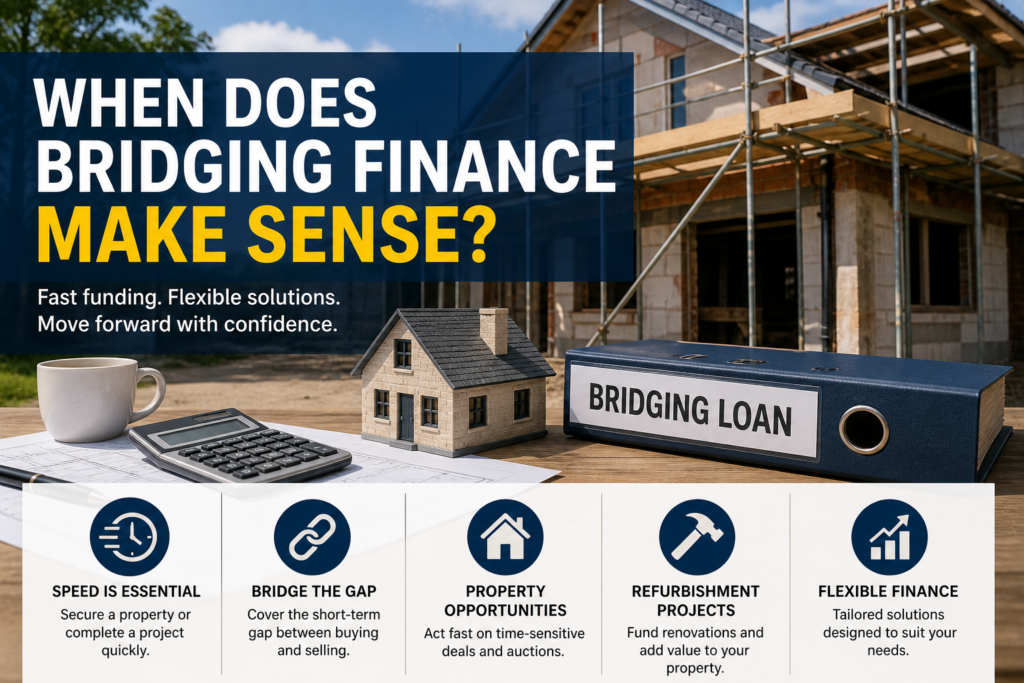
Bridging finance works best when speed directly creates value.
It is particularly suitable if:
- The property is not mortgageable in its current condition
- You are purchasing below market value and planning to add value
- You have a clear and realistic exit strategy
- The projected profit comfortably covers all costs
Many investors later refinance through long-term lenders or work with development finance lenders UK for larger or ongoing projects.
Also Read – The Smart Way to Buy Property Using a Bridging Loan UK
Practical Tips Before You Commit
Small mistakes in bridging finance can become costly.
Keep these points in mind:
- Avoid relying on overly optimistic property valuations
- Allow extra time for your exit strategy
- Include a contingency buffer in your refurbishment budget
- Work with experienced solicitors and brokers
- Compare multiple lenders rather than choosing solely based on speed
If your project involves commercial or mixed-use property, exploring options from the best commercial mortgage lenders UK may offer better long-term flexibility.
Final Thoughts
Bridging loans for renovation are not just about speed. They are about timing, planning, and execution.
Used correctly, they can unlock opportunities that traditional finance cannot support. Used poorly, they can quickly become expensive.
If you are considering your next refurbishment project, take the time to structure it properly. Explore tailored options through trusted providers of bridging loans UK, run accurate numbers, and ensure your exit strategy is solid before committing.
Preparation is often the difference between a profitable project and a difficult one.
FAQs
- What is bridging finance for property renovation?
It is a short-term secured loan used to buy or refurbish a property quickly, usually repaid through sale or refinancing.
- How do bridging loans work for refurbishment projects?
You borrow against a property, complete the renovation, and repay the loan within a short period using a planned exit strategy.
- How quickly can I get a bridging loan in the UK?
Most bridging loans are completed within 1 to 3 weeks, depending on valuation and legal processes.
- Can I use bridging finance for heavy refurbishment?
Yes, although funding may be released in stages and lenders will assess the project in greater detail.
- How do I apply for bridging finance in the UK?
Prepare your project details, define your exit strategy, work with a broker, and submit the required documents for approval.
Discover the Latest Trends
Stay informed with our latest articles and resources.